Imagine a performance marketer tasked with launching a new direct-to-consumer (DTC) campaign. They spend three hours meticulously crafting a complex, 500-word prompt to generate the “perfect” hero image. They wait for a high-parameter model to render a heavy, high-resolution file, only for the creative to be rejected by the Facebook Ad Manager for composition issues, or worse, to launch and see a sub-1% click-through rate (CTR). This is the “Artisanal Prompting Trap”—a labor-intensive approach that prioritizes individual asset quality over the statistical probability of finding a winner through volume.
In high-scale media buying, the “perfect” prompt is a tactical liability. Success in the current creative-led growth environment depends on throughput: the ability to generate, test, and iterate on dozens of visual hooks simultaneously. Achieving this requires a fundamental shift from artisanal creation to systematic workflows, specifically by leveraging high-velocity models like Nano Banana AI to fuel rapid iteration loops.
The Efficiency Trap of One-Shot Prompting
The common mistake in generative workflows is treating the AI like a digital artist rather than a high-speed rendering engine. When a team attempts to scale to 50+ ad variations for a single campaign, the “one-shot” approach—where you try to get the final image in a single generation—fails. It fails because AI, by its probabilistic nature, produces “hallucinations” or aesthetic drift that often requires human intervention anyway.
Furthermore, relying on heavy, high-parameter models for every initial draft is an inefficient use of resources. If your objective is to test whether a “neon-lit kitchen” background performs better than a “sun-drenched patio” for a kitchenware ad, you do not need a K-level upscale on the first try. You need speed.
The goal should be to move the finish line. Instead of aiming for “perfection” in the first prompt, the objective is to produce “high-probability candidates.” By lowering the stakes of the initial generation, you can explore a wider range of creative angles. In a systems-minded workflow, the first 20 images are not the final product; they are the raw data used to inform the next iteration.
Architecting the Loop: Source Assets over Syntax
The most significant bottleneck in AI creative production is often the text prompt itself. Natural language is imprecise. If you ask for a “minimalist aesthetic,” the AI’s interpretation may not align with your brand’s style guide. To maintain brand consistency at scale, creators should prioritize source assets over complex syntax.
Using a base composition or a reference image—often referred to as an image-to-image workflow—provides the model with a structural “control variable.” When using Nano Banana for creative testing, the source asset acts as the anchor. You aren’t asking the AI to imagine a product; you are providing the product’s geometry and asking the AI to manipulate the environment, lighting, and mood around it.
This approach significantly reduces creative drift. In a performance marketing context, this allows for “Multivariate Creative Testing.” You keep the product (the control) constant while varying the background, the model’s demographics, or the color palette (the variables). This level of precision is nearly impossible to achieve through text prompts alone, which frequently struggle to maintain object permanence across multiple generations.
Model Selection for Throughput: Why Nano Banana AI Wins in Testing
In the hierarchy of creative production, there is a time for slow, heavy models and a time for high-velocity engines. For the testing phase—where the goal is to identify which “hook” resonates with a specific audience segment—latency is the enemy.
Nano Banana functions as the engine for this high-volume draft phase. Because the model is optimized for speed and efficiency, it allows a creator to generate 10 variations in the time a larger model takes to produce one. This is not just a matter of convenience; it changes the economics of the creative process. If a media buyer can see 100 variations of an ad concept in 10 minutes, they can identify the top 5% of visual performers before committing significant budget or upscaling time.
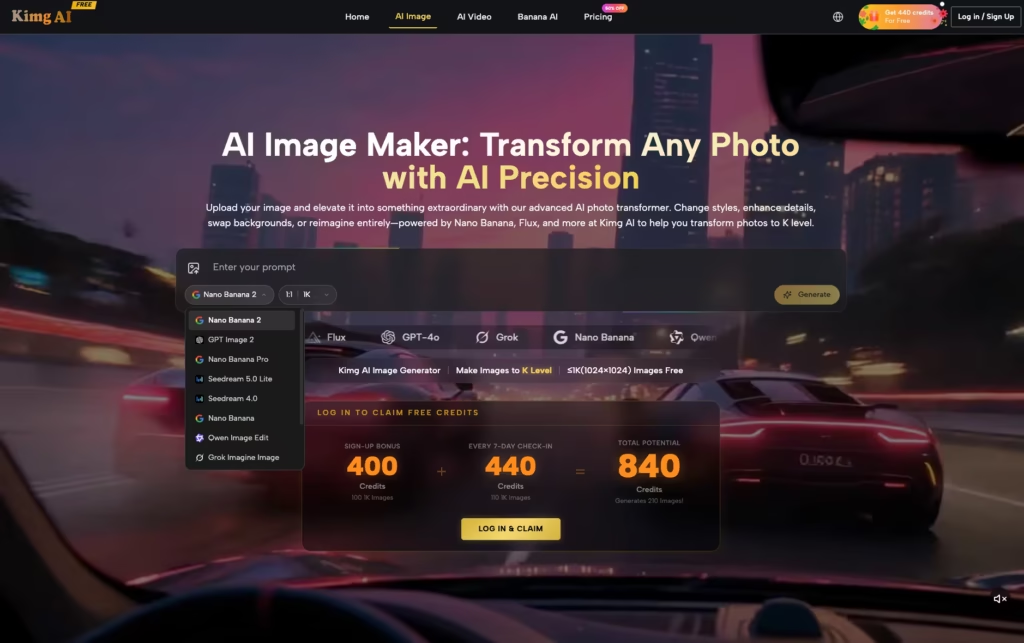
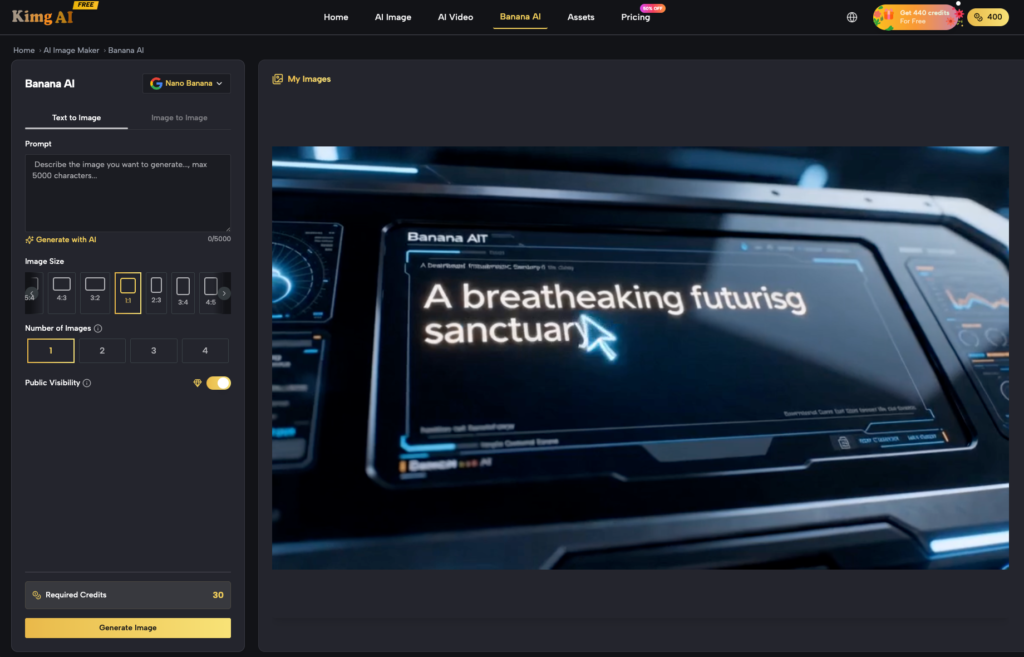
Operationalizing the Kimg AI toolset involves a two-stage pipeline:
- Exploration: High-volume generation using Banana AI and its faster variants to test diverse concepts (e.g., “retro-futurist” vs. “lifestyle-authentic”).
- Refinement: Selecting the winning low-fidelity “seeds” and moving them into a K-level upscaler or a specialized editor for final polish.
This “funnel” approach to asset creation mirrors the performance marketing funnel itself, ensuring that only the most viable creative concepts receive the highest level of technical resources.
Variable Injection: Refining the Iteration Cycle
Once a baseline composition is established, the workflow moves into variable injection. This is the process of layering specific modifiers across a batch of images to see which nuances drive performance.
For instance, a performance marketer might take a winning product layout and run an iteration cycle focusing on “lighting variables.” One batch might use “Golden Hour” lighting, another “High-Contrast Studio,” and a third “Soft Overcast.” By keeping the core prompt and source image the same, the marketer can isolate lighting as the sole reason for a change in CTR.
This iterative prompting requires a disciplined approach to modifiers. Rather than rewriting the entire prompt, the operator should only change 10-15% of the text. This “delta” (the change) becomes the focus of the experiment. However, it is important to note a current limitation in these workflows: cross-model consistency. In our testing, a winning prompt or seed in one environment rarely survives a direct port to another without significant recalibration. This “prompt brittleness” means that once you find a successful loop within a specific toolset, it is often more efficient to stay within that ecosystem than to try and replicate the results elsewhere.
Boundary Conditions and the Uncertainty of AI Coherence
Despite the efficiency gains of high-velocity loops, there are clear boundary conditions that every operator must acknowledge. High-speed models are designed for throughput, not necessarily for pixel-perfect anatomical accuracy or fine-grained text rendering.
One persistent challenge is the rendering of text on product labels or background signage. While some progress has been made, the current state of the technology often produces “gibberish” text when tasked with complex background elements at high speed. For performance marketers, this means that any ad requiring specific copy within the image itself will still require a secondary post-production step—typically a manual overlay in a design tool or a specialized in-painting pass.
There is also the human-in-the-loop requirement regarding brand safety. Automated loops can occasionally produce “hallucinations” that, while aesthetically pleasing, might violate brand guidelines or platform policies (such as uncanny valley facial features or distorted product geometry). No matter how automated the iteration loop becomes, a human curator is still essential to vet the “winning” outputs before they hit the ad account.
Finally, we must manage expectations regarding “infinite” variety. There is a point of diminishing returns where generating the 501st variation of an ad provides zero incremental value over the 50th. “Prompt fatigue” can set in for the human operator, where the nuances between versions become so slight that they no longer represent distinct testable variables. The key is knowing when the loop has provided enough data to make a commercial decision, rather than chasing an elusive, non-existent “perfection.”
By treating generative AI as a high-throughput testing engine rather than an artisanal tool, performance marketers can move faster, spend less on failed creative, and ultimately find the winning hooks that drive actual business outcomes. The focus should always remain on the system, not the individual prompt.