A creative operations lead for a mid-sized e-commerce agency once described their first month with generative tools as “the most expensive free experiment in history.” On paper, the team was producing images in seconds using high-fidelity models. In reality, those images sat in a purgatory of Slack threads and Jira tickets because a hand had six fingers, a logo was slightly skewed, or the lighting didn’t match the secondary product shot. The “speed” of generation was being entirely negated by the friction of refinement.
This is the hidden cost of the generative boom. When we treat AI as a slot machine—pulling the lever on a prompt and hoping for a win—we ignore the production logic required to actually ship a brand-compliant asset. For professional workflows, the value of a tool is no longer measured by the quality of its first “guess.” It is measured by how quickly an editor can fix the inevitable errors.
The 90/10 Friction Point in Generative Workflows
In traditional creative production, the “90/10” rule is a standard budgeting hurdle: 90% of the work is often done in the final 10% of the timeline. In the context of AI, this ratio has become even more skewed. A model like GPT Image 2 or Gemini 3 Pro can generate a stunning visual in under thirty seconds. However, if that visual is intended for a hero banner or a social ad, it almost certainly contains a “hallucination”—a stray artifact, a blurred texture, or a compositional imbalance—that renders it unusable for high-stakes publishing.
The operational bottleneck occurs immediately after the “Generate” button is pressed. If the creator has to export that image, open a separate heavy-duty suite, mask the error, and attempt a manual fix, the time-to-market advantage of AI evaporates. This “last-mile” friction is where most creative pipelines break. We are seeing a transition from “prompt engineering,” which was the obsession of 2023, to “workflow orchestration,” where the goal is to keep the asset within a controlled environment until it is 100% ready for the CMS.
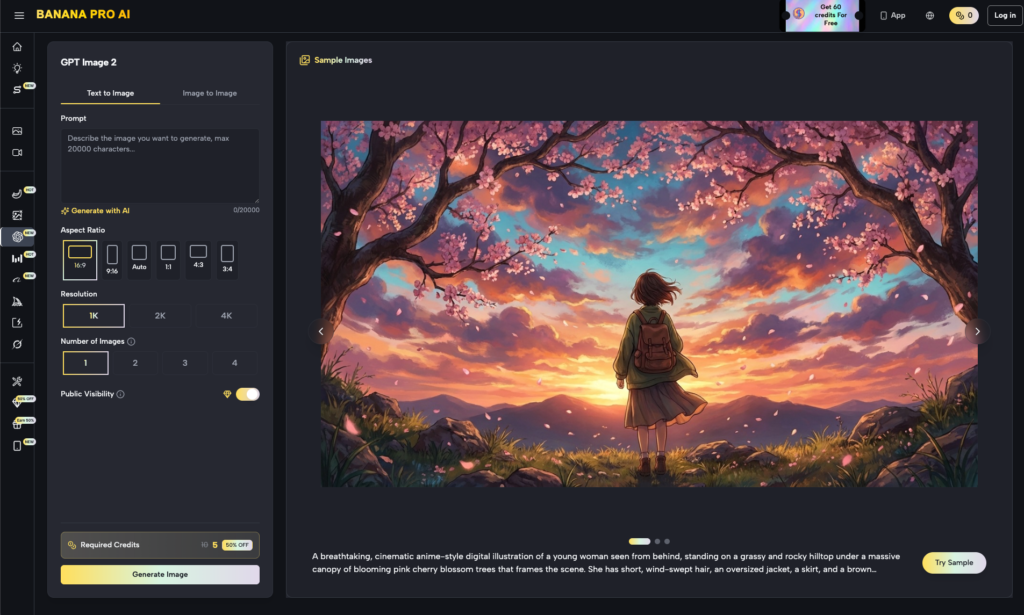
Benchmarking Throughput: Drafts vs. Final Assets
When evaluating a production stack, latency is a deceptive metric. A tool might have a five-second server response time, but if the output requires four regenerations to get the composition right, the functional latency is several minutes.
Evidence from production-focused teams suggests that centralized environments reduce asset rejection rates by roughly 30%. This isn’t because the underlying models are magically better; it’s because the cost of “fixing” is lower than the cost of “restarting.” In a fragmented workflow, a creator might spend ten minutes jumping between a Discord-based generator and a local retouching app. In a unified hub like Nano Banana, that context-switching is eliminated.
There is also a significant difference between a “generate-until-perfect” strategy and a “generate-and-fix” strategy. The former relies on the randomness of the model, which is statistically inefficient. The latter treats the AI as a high-end drafting partner, allowing a human editor to step in and guide the final pixels. For agencies billing by the project, the “generate-and-fix” approach is the only one that offers a predictable ROI.
The Nano Banana Framework: Moving Beyond the Single Prompt
The reality of the current AI market is that no single model wins every category. One model might excel at photorealistic textures, while another—like Midjourney or Grok—might have a superior “vibe” for conceptual art.
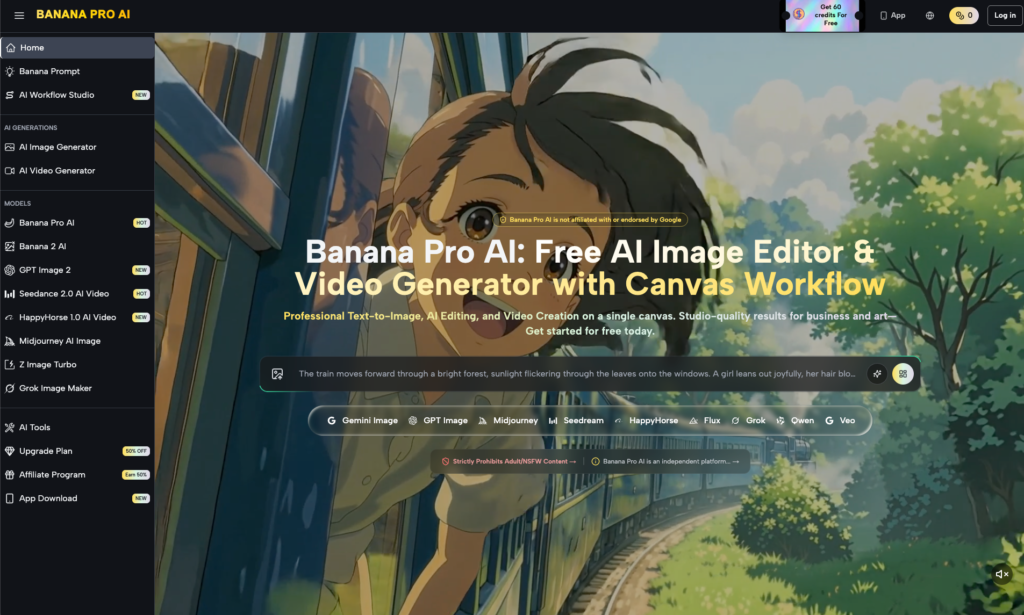
This is why the architecture of Nano Banana represents a shift in how creative operations are built. Rather than locking a team into a single proprietary engine, it functions as a multi-model ecosystem. Having access to Gemini 3.1 Flash for rapid ideation alongside Seedance 2.0 for video-first assets allows a lead to choose the right tool for the specific tactical need.
From a systems perspective, the advantage here is architectural. When you have Gemini Omni and various image makers under one roof, you can maintain stylistic consistency across a campaign. If you generate a character in an image model, the ability to immediately transition into a video workflow without re-uploading assets to three different platforms is a massive operational win. It turns a collection of “toys” into a hardened production stack.
Integrated Retouching: When to Deploy the AI Image Editor
Most AI tools are built for the “wow” factor of the initial image. However, the professional user needs the “how” factor of the modification. This is where a dedicated AI Image Editor becomes the most valuable tool in the shed.
Unlike a generic AI Photo Editor that might only offer broad filters, an integrated editor allows for regional control. If a model generates a perfect interior design shot but places a nonsensical object on the coffee table, a broad prompt won’t fix it. You need in-painting capabilities that understand the surrounding context.
However, we must be honest about the technical limits: in-painting is not a magic wand. There are moments where a pixel-level manual fix in a traditional editor is still faster than trying to coax an AI to understand a very specific geometric correction. The goal of using an AI Image Editor within a platform like Banana AI is to handle the 80% of “cleanup” tasks—removing artifacts, upscaling resolution, or expanding a background—so the human editor only spends their high-value time on the remaining 20% of creative nuance.
The Uncertainty Principle: What AI Still Can’t Solve
Despite the rapid advancement of Banana AI and other platforms, there are several areas where expectation-management is crucial for creative leads.
First, the typography problem remains a persistent hurdle. While models are getting better at rendering short strings of text, no current model can be trusted for text-heavy hero images or complex layouts. The “mushy text” syndrome is still common, and relying on AI for final-copy rendering is a recipe for brand embarrassment.
Second, there is the risk of “stylistic drift.” If five different creators on a team are using the same tools without a unified “brand seed” or reference image, the outputs will eventually diverge. Even the best AI Photo Editor cannot enforce brand guidelines if the human operators aren’t aligned.
Finally, the challenge of copyright transparency and the “black box” nature of training data remains an unresolved legal frontier. While tools offer the ability to generate “commercial-ready” assets, companies must still apply a layer of editorial oversight to ensure that generated content doesn’t inadvertently mimic protected intellectual property too closely.
Infrastructure for the Next Creative Cycle
The “toy” phase of generative AI is ending. We are moving into a period where the focus is on building resilient, repeatable pipelines that can handle high-volume publishing without sacrificing quality.
A resilient workflow is one that prioritizes the editor’s control over the model’s randomness. It assumes that the first generation will be 90% correct and provides the tools—like the retouching features in Nano Banana—to bridge that final 10% gap quickly.
To achieve true creative ROI, teams must move away from the allure of the “magic prompt” and focus on the boring, practical reality of asset management and integrated editing. The platforms that will survive this cycle are those that stop acting like casinos and start acting like workstations. In the end, the most powerful feature of any AI tool isn’t what it can create from nothing; it’s how easily it allows a human professional to turn a “good enough” draft into a “ready to publish” asset.